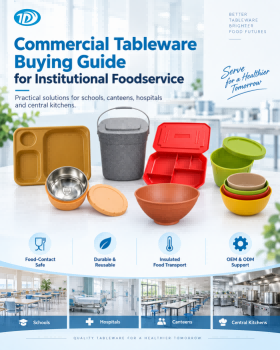
Commercial Tableware Buying Guide for Institutional Foodservice
Sep 22, 2026
Institutional foodservice requires tableware that can handle frequent use, large meal volumes, repeated cleaning, and standardized meal distribution.
Schools, hospitals, corporate canteens, factories, central kitchens, and catering operations usually need products with stable materials, practical structures, and reliable bulk supply.
1. Choose the Right Material
Different materials are suitable for different applications.
PP tableware is lightweight, reusable, and widely used for serving trays, compartment lunch boxes, bowls, and plates.
304 stainless steel products offer strong durability and are suitable for canteens, hospitals, schools, and other high-frequency foodservice environments.
For hot meal transportation, insulated structures such as EPP, EPS, and PU can help reduce heat loss during distribution.
Pacific Plastic supplies a range of products including:
PP serving trays
2/3/4/5-compartment lunch boxes
304 stainless steel lunch plates and lunch boxes
Plastic-coated stainless steel lunch boxes
Bowls and plates
Insulated food boxes and buckets
2. Match the Product to the Application
Different institutions require different tableware configurations.
Schools and Canteens
Compartment lunch boxes are commonly used for portion control and standardized meal service.
Pacific Plastic offers 2-, 3-, 4-, and 5-compartment lunch boxes, suitable for school meals, factory canteens, and institutional dining.
Reusable PP serving trays can also support cafeteria-style meal service.
Hospitals and Institutional Catering
Meal distribution often requires products that are easy to handle, clean, and repeatedly use.
Stainless steel lunch plates, compartment lunch boxes, bowls, and serving trays can be selected according to different meal delivery systems.
Central Kitchens
Central kitchens usually require both tableware and food transport solutions.
Products such as insulated food boxes, insulated buckets, rice boxes, and soup containers can support bulk meal distribution between production kitchens and serving locations.
Pacific Plastic currently provides multiple insulated container capacities, including solutions for soup, rice, prepared meals, and large-scale catering transport.
3. Focus on Durability and Reuse
Institutional tableware is often used several times per day.
Important purchasing factors include:
Impact resistance
Repeated washing performance
Stackability
Easy handling
Stable structure
Long service life
For large-scale foodservice operations, reusable products can help simplify daily replacement and inventory management.
4. Select Suitable Sizes and Compartments
Compartment design should match meal structure and portion requirements.
For example:
2-compartment lunch boxes for simple meal combinations
3-compartment lunch boxes for staple food, main dish, and side dish
4- and 5-compartment lunch boxes for more standardized meal distribution
Serving tray size should also match cafeteria counters, dishwashing equipment, storage racks, and transport systems.
For hot meal delivery, insulated containers should be selected according to food type and transport volume.
5. Consider Food Transport Requirements
Institutional foodservice often involves more than serving meals at one location.
Central kitchens, school meal programs, hospitals, and catering companies may need to transport prepared food over short or medium distances.
Pacific Plastic supplies:
EPP insulated food boxes
Round insulated buckets
Rice transport boxes
Soup containers
Large-capacity insulated food containers
These products are designed for reusable commercial food transportation and can be combined with tableware systems for complete meal distribution.
6. Check Food-Contact Compliance
Commercial buyers should confirm that tableware meets the applicable food-contact requirements in the target market.
Pacific Plastic supports foodservice projects with relevant quality and compliance systems, including:
ISO 9001
ISO 22000:2018
HACCP
FDA 21 CFR
EC 1935/2004
EU 10/2011
REACH SVHC
Material traceability and inspection processes should also be considered during supplier evaluation.
7. Evaluate the Manufacturer
For bulk procurement, buyers should consider more than product price.
A suitable manufacturer should be able to support:
Stable bulk production
OEM and ODM development
Custom colors
Logo customization
Mold development
Different sizes and structures
Quality inspection
Long-term supply
Pacific Plastic manufactures reusable commercial tableware and insulated food transport products for foodservice distributors, catering companies, institutions, and OEM projects.
Choosing the Right Commercial Tableware
The right institutional tableware depends on the meal type, serving method, daily volume, cleaning system, storage space, and transport requirements.
A complete solution may include serving trays, compartment lunch boxes, stainless steel products, bowls, plates, and insulated food transport containers rather than a single product.
For schools, hospitals, canteens, central kitchens, and institutional catering projects, selecting compatible products from one manufacturing system can help simplify procurement and product standardization.
Read More