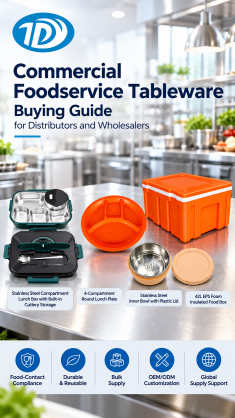
Commercial Foodservice Tableware Buying Guide for Distributors and Wholesalers
Sep 30, 2026
For distributors and wholesalers, sourcing commercial foodservice tableware requires more than comparing unit prices. Material, durability, food-contact compliance, packaging efficiency, and supplier stability all affect long-term purchasing results.
1. Choose Products by Application
Different foodservice environments require different products.
Typical applications include:
Restaurants and cafés
Hotels
Schools and corporate canteens
Hospitals
Central kitchens
Catering and meal delivery
Common product categories include serving trays, compartment lunch boxes, reusable bowls and plates, stainless steel tableware, and insulated food transport containers.
2. Select the Right Material
Material choice directly affects durability, weight, temperature resistance, and cost.
PP is widely used for serving trays, lunch boxes, bowls, and plates due to its lightweight structure and chemical resistance.
ABS offers good rigidity and surface appearance and is often used for selected commercial trays and structural parts.
PC is known for impact resistance and transparency and is commonly used for reusable drinkware.
304 stainless steel is suitable for high-frequency institutional and commercial meal service.
For insulated food transport, EPP, EPS, and PU are commonly used to provide thermal insulation.
3. Check Durability and Compliance
Commercial tableware must withstand repeated washing, stacking, handling, and daily use.
Important factors include:
Impact resistance
Rim and corner strength
Stackability
Surface durability
Lid and handle strength
Food-contact compliance should also match the target market.
Common standards may include:
FDA 21 CFR
EC 1935/2004
EU 10/2011
REACH SVHC
Factory systems such as ISO 9001, ISO 22000, and HACCP can also help buyers evaluate production and quality-control capability.
4. Consider Packaging and Logistics
For bulk purchasing, carton size and packing efficiency can significantly affect freight costs.
Before ordering, distributors should review:
Pieces per carton
Carton dimensions
Gross weight
Stackability
Container loading quantity
A well-designed stackable product can reduce storage and shipping costs.
5. Review Customization Capability
Wholesalers may require different colors, logos, packaging, or private-label solutions.
Common customization options include:
Custom colors
Logo printing
Laser marking
Private label
Packaging customization
Mold development
OEM/ODM support
MOQ, tooling cost, lead time, and projected annual volume should be confirmed before starting customized projects.
6. Evaluate the Supplier
A reliable supplier should support stable repeat production and consistent product quality.
Key points to review include:
Production equipment
Raw material control
Quality inspection
Mold management
Warehousing
Traceability
Export experience
A video factory tour can also help buyers verify production capability before larger orders.
Pacific Plastic Commercial Tableware Supply
Pacific Plastic supplies reusable commercial foodservice tableware and insulated food transport products for B2B customers.
Main categories include:
Commercial serving trays
2/3/4/5-compartment lunch boxes
Reusable bowls and plates
304 stainless steel compartment plates
Stainless steel lunch boxes
Insulated buckets
EPP insulated food boxes
Wholesale supply, private label, OEM/ODM, and customized product development are available for distributors, importers, and foodservice suppliers.
Conclusion
For distributors and wholesalers, the best sourcing decision should balance product quality, compliance, logistics efficiency, customization capability, and long-term supply stability.
Reviewing samples, specifications, compliance documents, packaging data, and factory capability before bulk purchasing can help reduce procurement risks and improve long-term
Read More